Wakefield Post Office
Contents
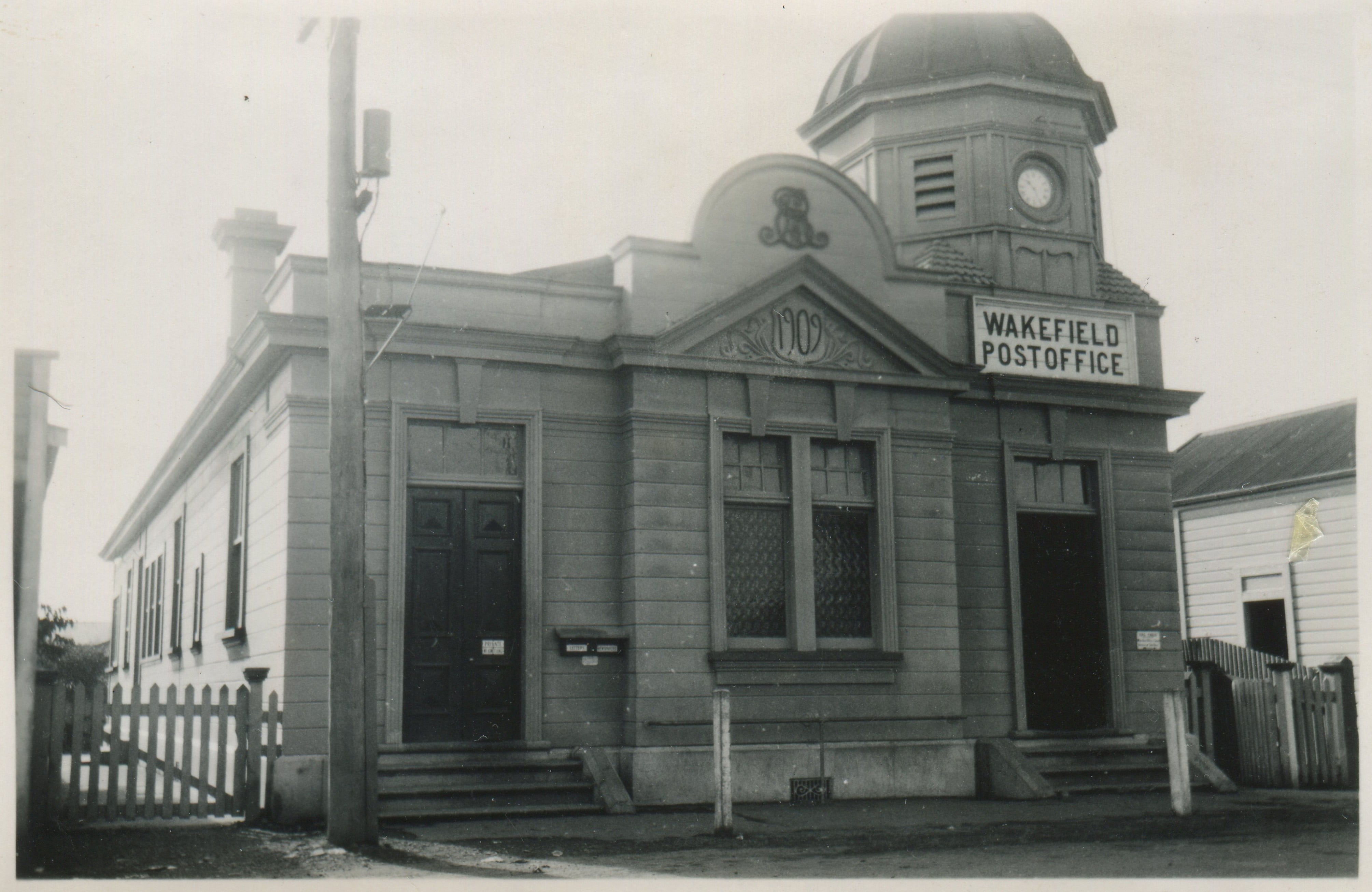
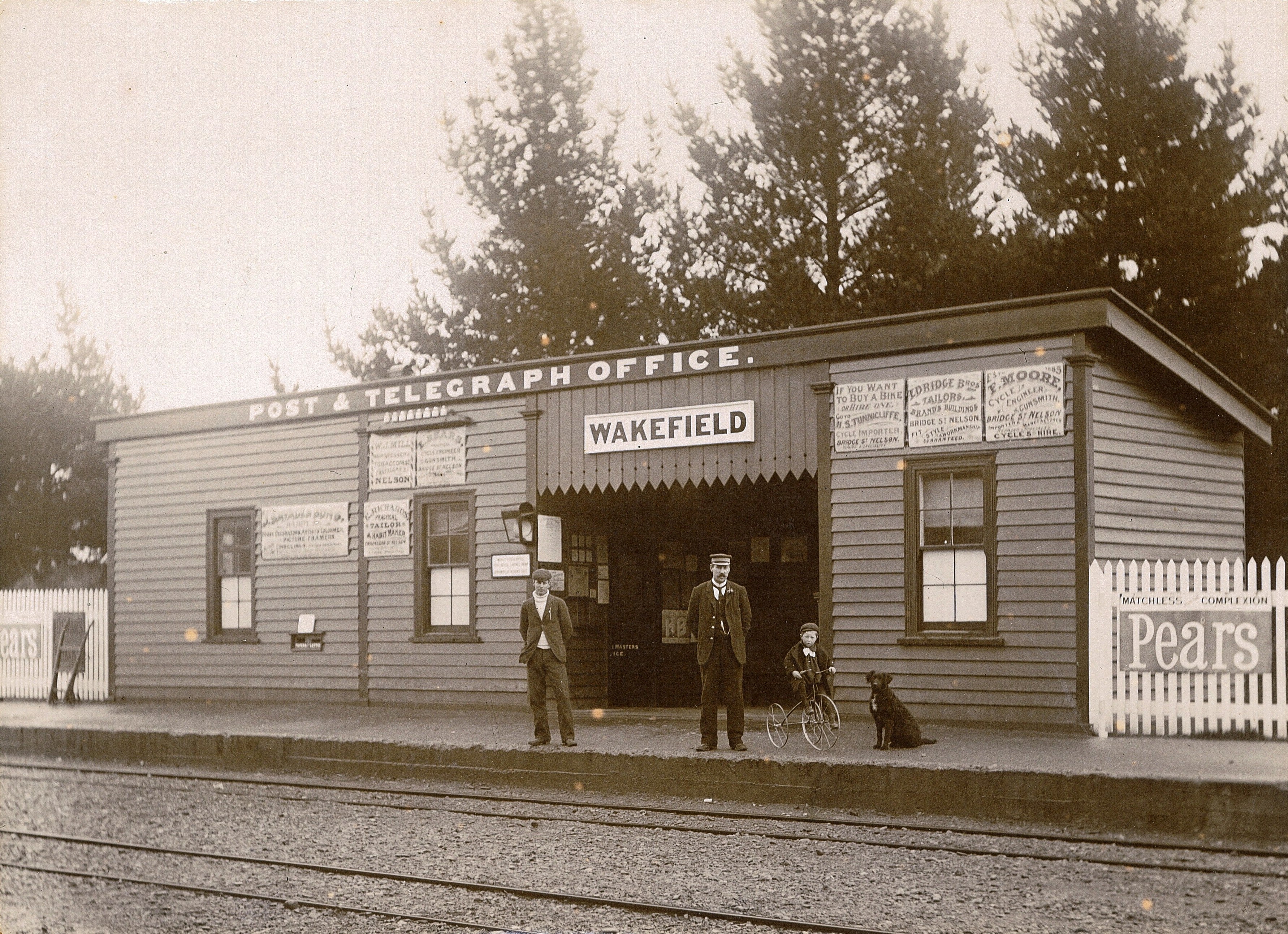
The development of the Post Office in Wakefield is inextricably linked with the settlement of Wakefield and the wider Waimea South area in the mid-19th through to the early 20th century. Initially mail and parcels were carried by individuals travelling in and out of Nelson, or by carriers of supplies, however tenders for contracted mail cartage soon appeared in the colonial newspapers. Mail was then handled from 1849 at the newly established Wakefield School, until the Railway reached Wakefield in 1876. Sometime in early 1878 the Post Office moved to the Railway station, where it stayed until a stand-alone Post Office was built in 1909. Following a formal, public opening in 1910 this building and its services continued with the implementation of many changes and alterations, serving the community until the doors were finally closed in 1990.
In the Beginning: 1849 - 1866
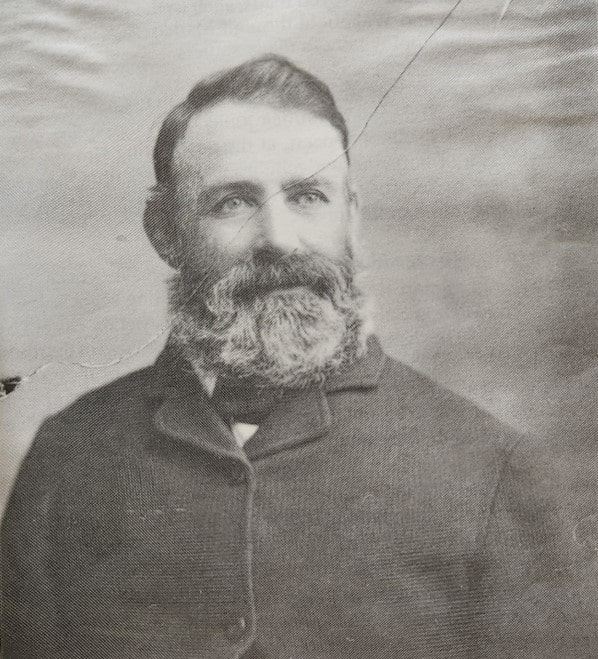
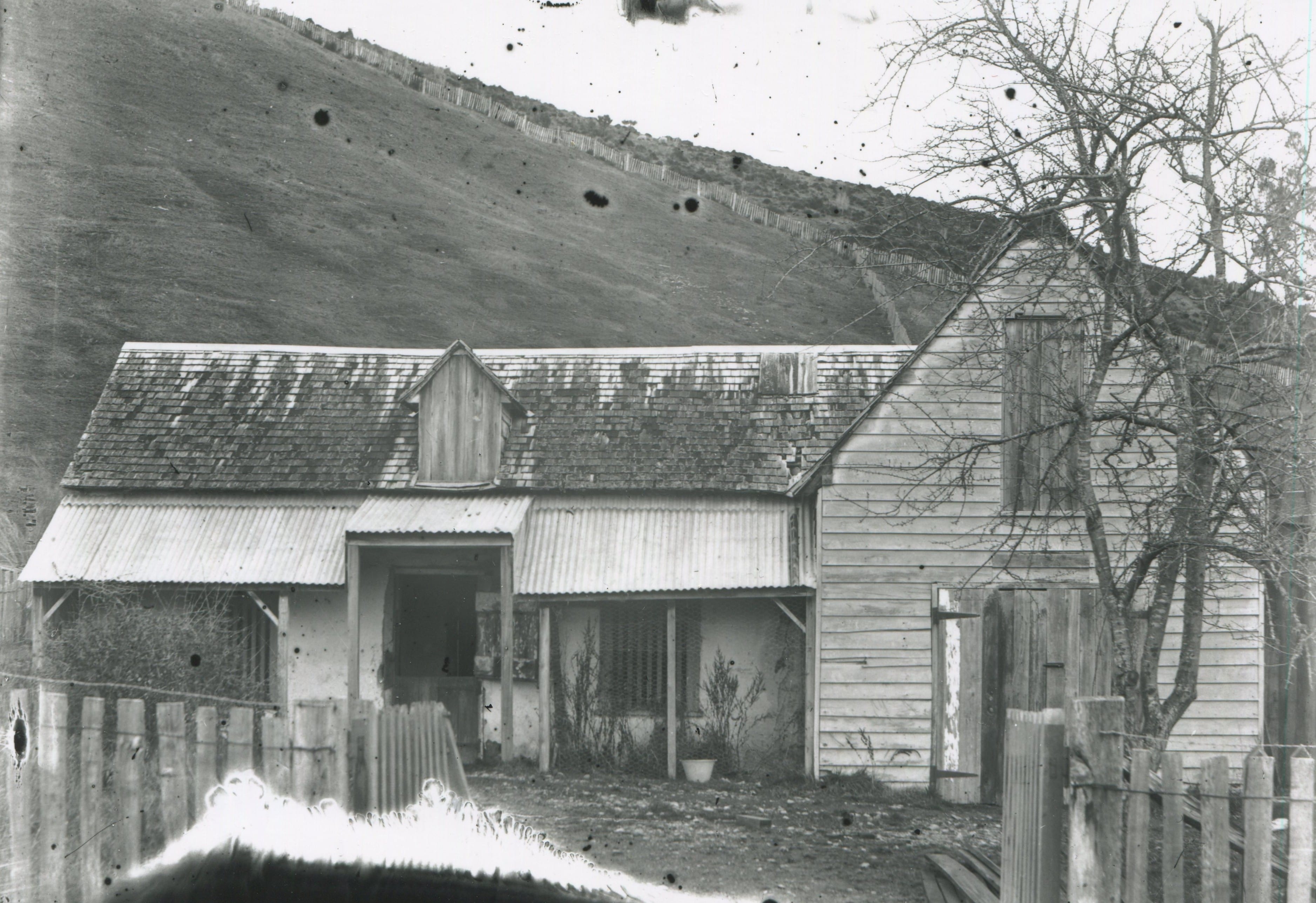
James Thomas Smith, one of the earliest school masters at the fledgling Wakefield School became the first recorded, but unofficial postmaster in the village. James, a barrister in England, sailed for New Zealand on April 27th, 1841, aboard the “Whitby” with Captain Arthur Wakefield and other male passengers. He received a commendation for teaching the men to read and write on the voyage out. He took up the position of Storekeeper at the New Zealand Company Headquarters in Nelson, but following the collapse of the Company he accepted the position of schoolmaster at Wakefield, also known then as “Pitfure”.1
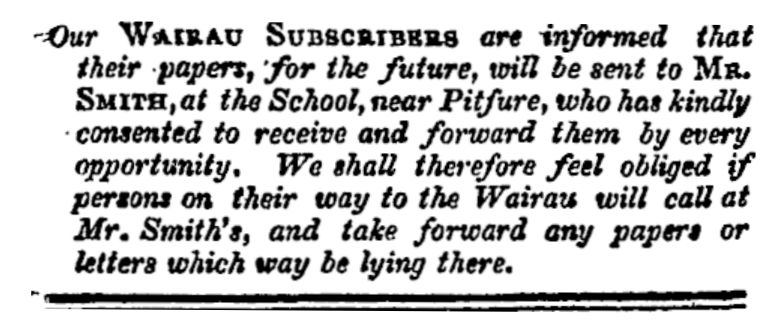
On May 26, 1849, the Nelson Examiner newspaper informed the public that “By a notice which we have addressed to our Wairau subscribers, it will be seen that Mr. Smith, at the school, near Pitfure, has kindly consented to receive papers (and, we may add, letters also) for the residents in the Wairau. If persons proceeding to the Wairau will have the kindness to call at the School on their way, it will be a great public convenience, until some better arrangement can be made to communicate with that district.”2
In the Nelson Examiner on the 12th of January 1850, a letter to the Editor advocated for a more formal arrangement for postal services, including a well-argued calculation of “sufficient revenue” to pay for it.
“From the best information to be gathered from the well informed as to the amount of population in the several districts within about thirty miles of Nelson, and taking a low average of the number of letters received by each family, it appears that a charge per letter of 3d., or even 2d. per letter for the Waimea district, up to the Wakefield school-house, and 4d. a letter for Motueka, it appears that a revenue sufficient to pay the annual expense of a man or lad and two horses, might be obtained, and all that is wanted besides is to make a road which is already passable by bullock carts, traversable by a light one-horse cart. Such a mail-cart might leave Nelson by midday, and proceed to the school - house at Wakefield, and thence to Mr. John Palmer's public-house, at the Waimea village, the same - afternoon, and early next morning might proceed to Motueka, and back the same day with a fresh horse as far as Richmond, and early next morning return to Nelson. A day's interval would afford rest to both horses: and what a convenience would not such a cart afford to those men of business in the district who have communications to make with Nelson? I remain, sir, &c, Delta. Motueka, Jan. 7.”3
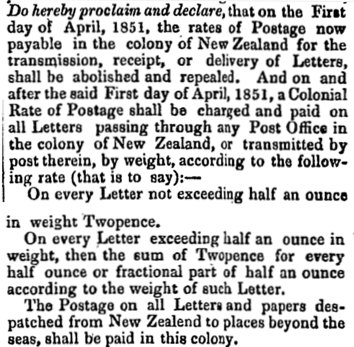
Pressure from the settlers must have convinced authorities because Post Office records confirm the commencement of a postal service in 1852. James Smith most likely recorded volumes of mail sent out and received in a ledger, and probably marked mail in some way to record monies paid for the mileage it would travel, or the destination.4 A Proclamation by Governor-General Grey, published in the Nelson Examiner March 8, 1851, stated that “a system of prepayment of Letters by stamps should be introduced into New Zealand, and to that end that the rates of Colonial Postage to be charged on all Letters be fixed according to the weight thereof, and without reference to the distance or number of miles the same may be conveyed.”5
In the same Proclamation, Governor Grey announces the establishment of new, standardised postal charges by weight.
Following the death of his mother in England, Mr Smith returned there to settle affairs and collect an
inheritance. When he returned to Wakefield he continued teaching until a replacement could be appointed,
then resigned and took up a position at Nelson Boys School.6
John Squire became the first state appointed headmaster of Wakefield School in 1856, and the second postmaster on a salary of 12 pounds per year. John was born in Clapham, Surrey on the 4th of March 1823. He trained as a chemist in London in 1837 and on Friday 15th of August 1851, John, his wife Eliza, and four children sailed for New Zealand. He practised as a qualified chemist on arrival and in the 1853 – 1864 New Zealand Electoral Roll, John is listed as “chemist, freeholder, leaseholder and house holder in Wakefield” 7
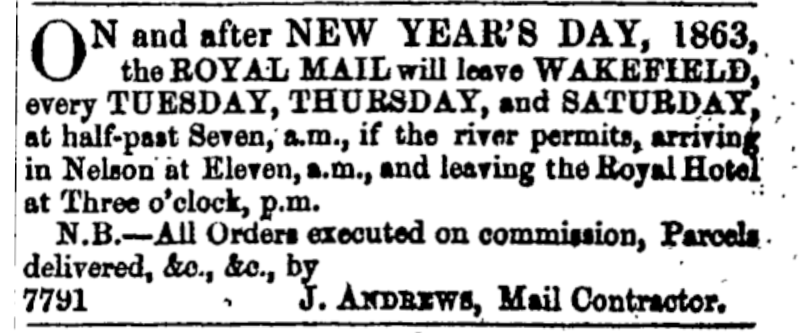
Mails were by now being delivered regularly to Wakefield by contractor Mr J Andrews. On the 12th of December 1859, an advertisement in the Nelson Examiner called for tenders to deliver mails Tuesday and Saturday between Nelson, Waimea West, Spring Grove and Wakefield, from the 1st of January 1860 for 12 months.12
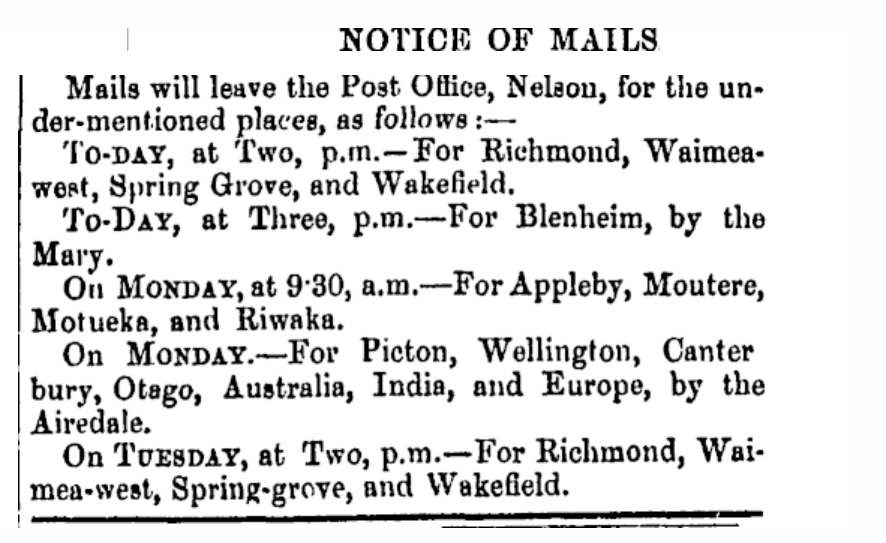
With Wakefield School rapidly outgrowing the original cobb building, even with its additions and extensions, it soon became apparent to the Provincial Government that a new building was needed. Marion Stringer records the school children being most excited about moving into their new building in 1860, and the Post Office moved with them.13 From this year Mail was being delivered three times a week, with the addition of a Thursday run.
In 1866, John Squire was relieved of his position as Postmaster at Wakefield, due to “inefficiency” and allegedly damaging the date stamp (Obliterator E5). He was penalised one month’s salary to pay for the damage, which at one pound must have been substantial.14 He moved his family to Spring Creek and continued teaching there.
The Honourable Roderick McKenzie, in his 1910 Post Office opening day speech, spoke of a Mr Davis taking over from Mr Squire, but that the date of his appointment was not on record. Perhaps this was an interim appointment as Mr R J Malcombe was Gazetted in July to become the postmaster at Wakefield, having not long been appointed Headmaster at Lower Wakefield School.15
3 months later Richard Chattock was Gazetted “to be Postmaster at Wakefield, from 1 October 1866”.16
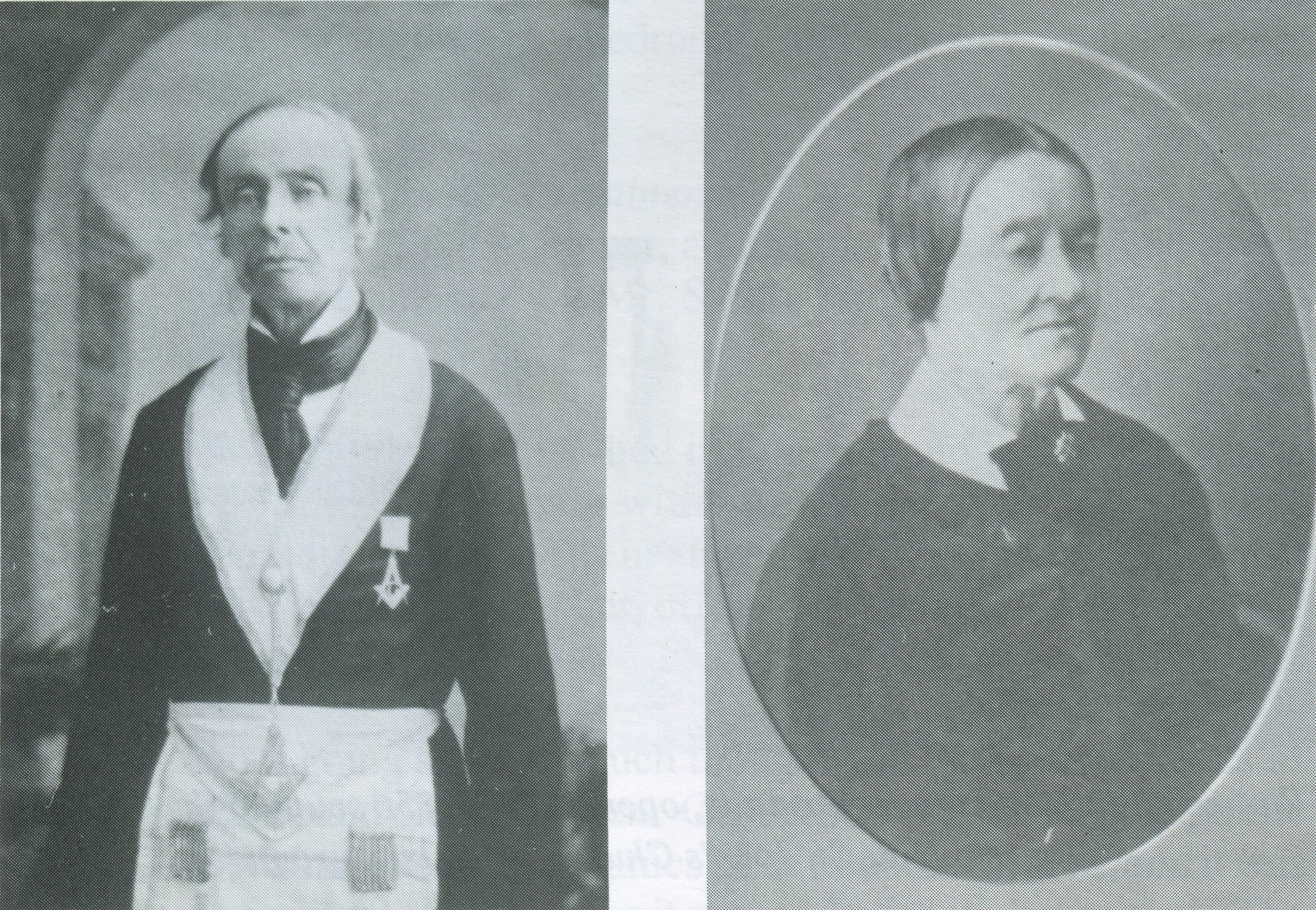
Richard and his wife both taught at Wakefield School for over a decade, and reports in the newspapers over that time show that he became well involved in the local community in addition to his teaching and Postal duties. In April 1875 he was appointed as Worshipful Master (WM) in the Forest Lodge Freemasons, and in June that same year he was appointed Registrar of Births, Marriages and Deaths, as well as Vaccination Inspector for Waimea South.17
Then in 1878 the Colonist Newspaper reported on the 20th of July ‘Farewell Presentation’ for Richard Chattock from his Lodge friends:
“On the lodge closing, an adjournment was made to the dining-room of the Forest lnn, where about twenty friends
assembled to say farewell, and present Mr Chattock with a small testimonial, as a mark of the respect they have
held him in for the past twelve years. A gold albert guard was presented by Mr P. C. Gouland in appropriate terms…
The friends then partook of a slight supper, song and sentiment closing a very pleasant evening, with hearty good
wishes to Mr Chattock and his family in their new home at Reefton.”18
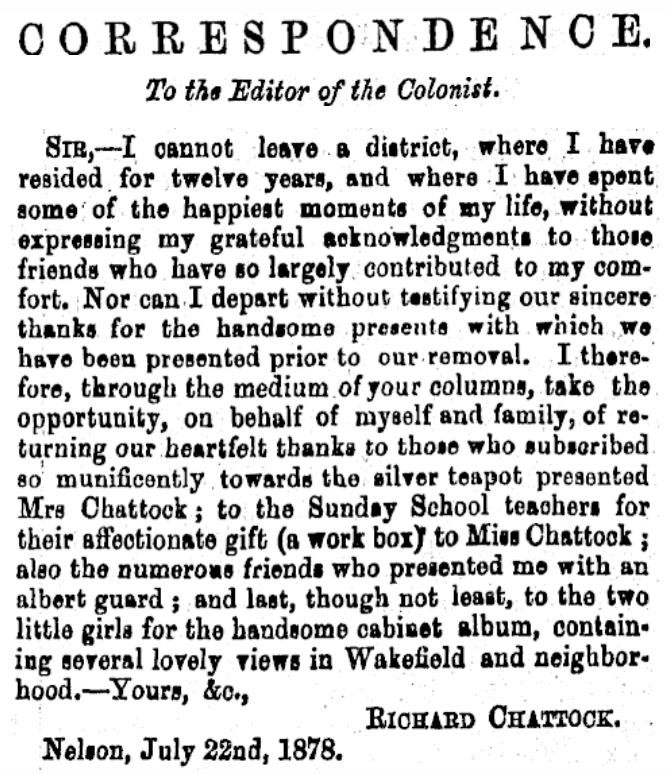
(Image right): Although moving to take charge of a much bigger school in Reefton, clearly Mr Chattock had strong feelings of connection
with Wakefield, as expressed in his Letter to the Editor on 23 July 1878.
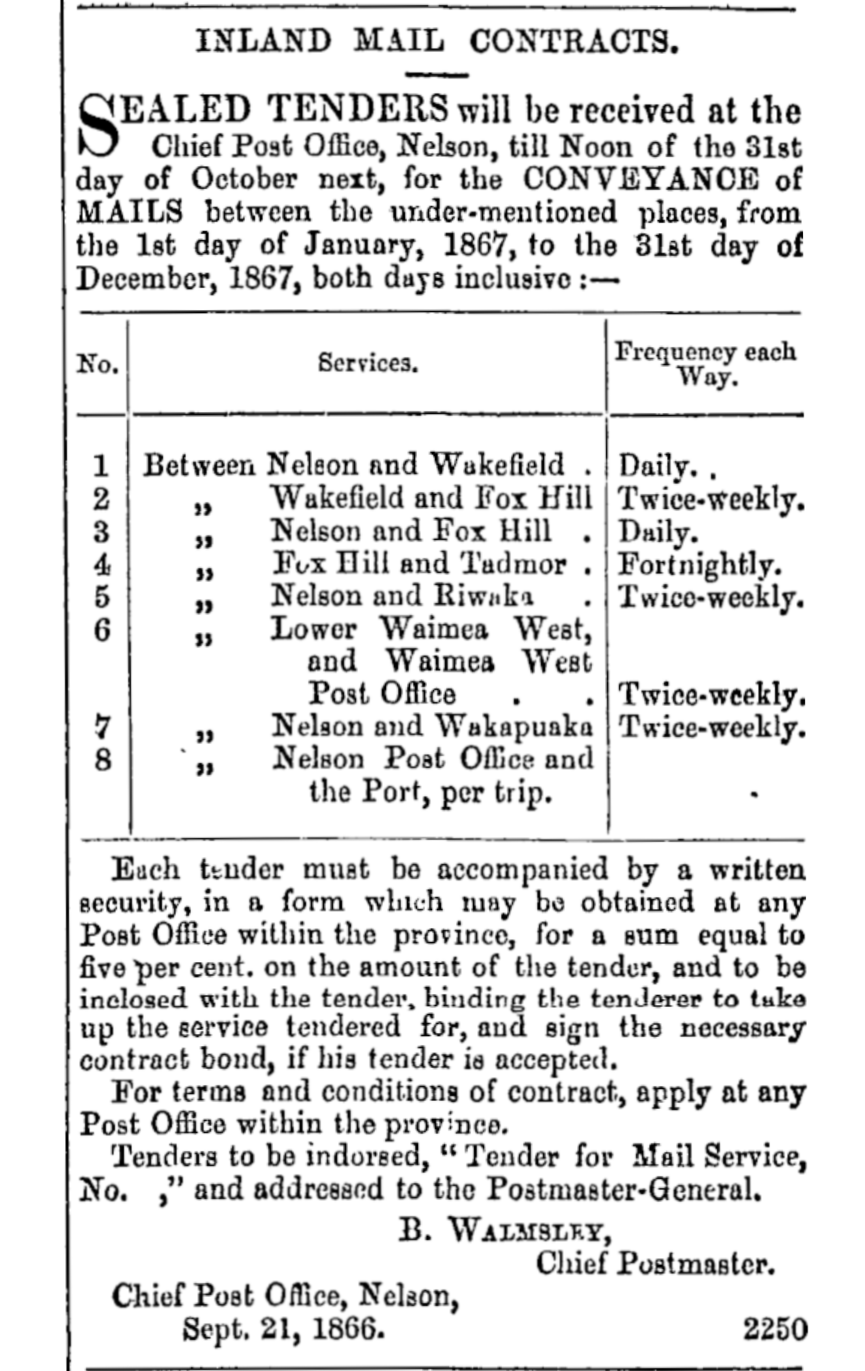
During this time the postal service was expanding. Mail was delivered three times per week, and successive notices of mail tenders published in the Newspapers show a widening area of mail delivery. 1866 shows a marked expansion in the tender for Inland mail contracts, with services between Nelson and Wakefield daily, and between Wakefield and Foxhill twice weekly. Mr Holder was the successful contractor for delivery this year.
The Railway Men: 1878 - 1909
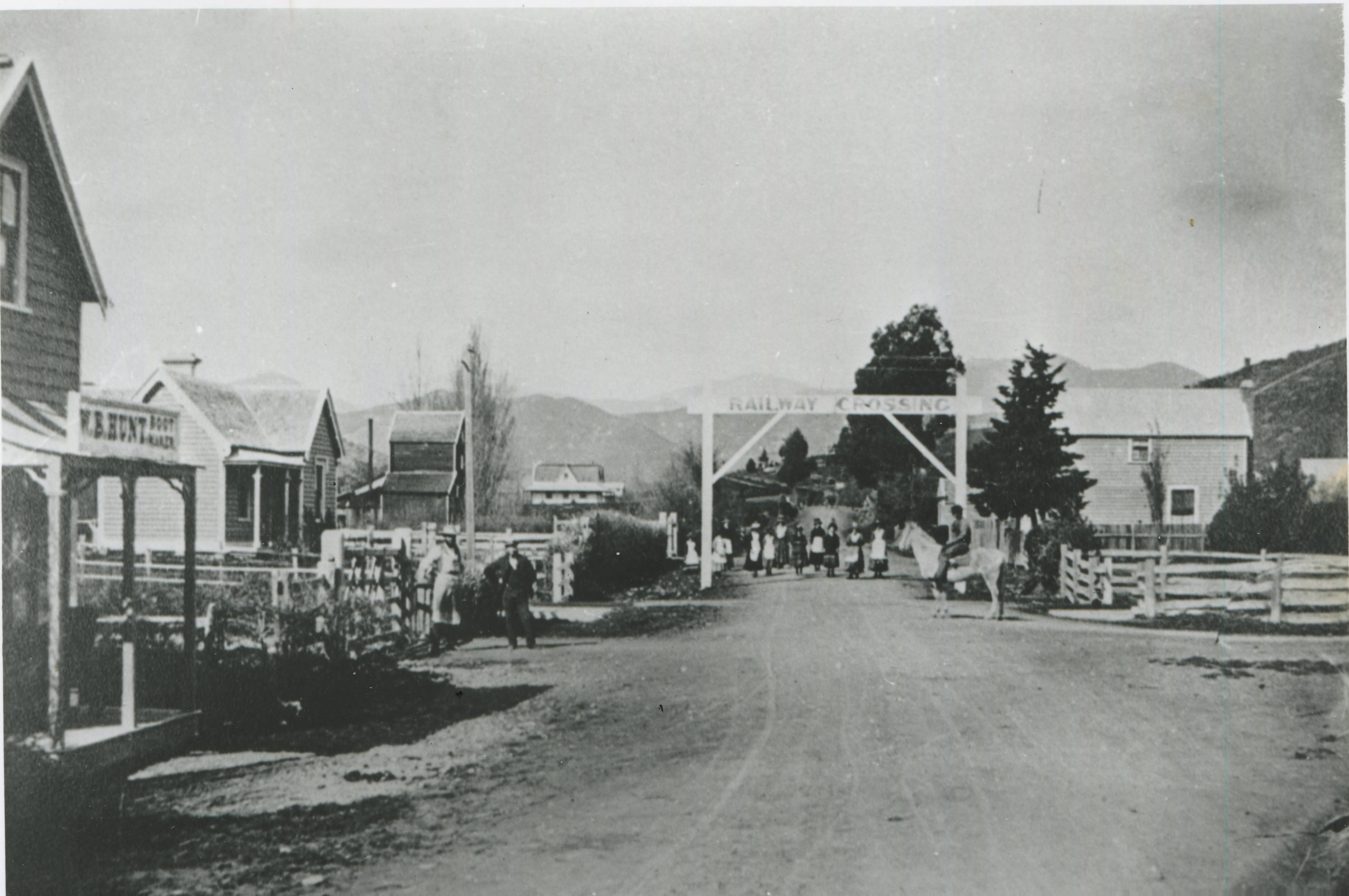
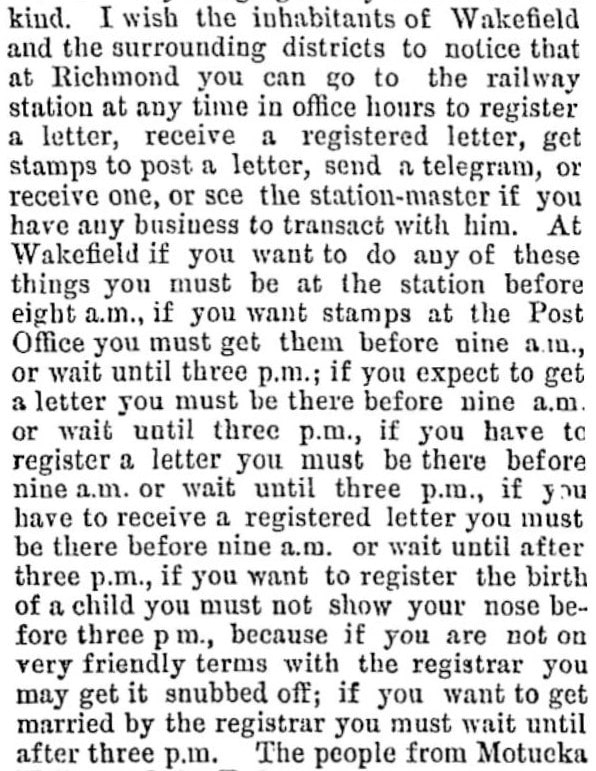
In 1876 the Railway reached Wakefield, bringing more progress for postal services. Sometime early in 1878 the Post Office was removed from the School and installed at the Wakefield Railway Station. However, in a letter to the Editor of the Nelson Evening Mail, 11th March 1878, we learn that Wakefield only had a travelling stationmaster, and the nearest telegraph office was at Foxhill, “one and a half miles beyond the railway terminus.” Consequently, the writer states, “if you want to send a telegram and are too late for the post you must either trudge up to Foxhill and back, 8 miles, or hang about until the 1.45 p.m. train comes down, and then ask the guard or stationmaster to oblige you by leaving it at Richmond”19 Below is an excerpt of his letter:
This inconvenience prompted the newspaper to publish its support on March 22nd:
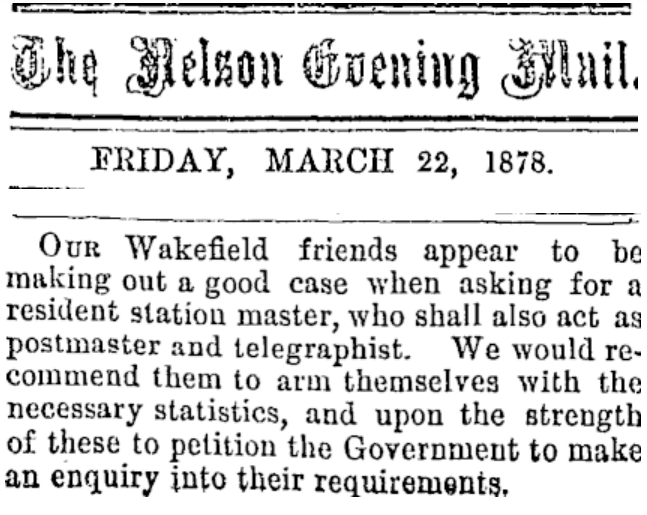
Followed by another report in the Mail the following month, dated 29th of April, of a meeting held at the Choral Hall, Wakefield, at which several motions were put forward and carried including:
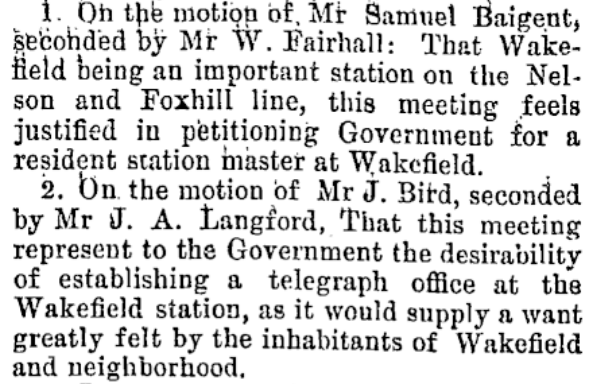
Mr W Painton also proposed that the Post Office and the Registrar’s Office be removed from the Railway Station ‘in consequence of the inconvenient hours these offices are currently open to the public’. This motion was not carried, however.
Further grumblings came from business owners such as shopkeeper Mr William Painton who complained to the Editor of the Evening Mail on May 6th, 1878, that “The Post and Registrar’s Office was a nuisance to us business people near the office, as persons in the outlying districts often came into the shop and spent threepence or sixpence, and stopped there for an hour or an hour and a half waiting for the office to open. Of course we cannot leave the shop while a customer is there, so that the present arrangement is a nuisance to those who are living in the neighbourhood of the office.”20
Mr William Austin was gazetted to be Postmaster and Stationmaster at Wakefield from the 18th of July, 1878.21Not long after this was posted, readers of the Nelson Evening Mail were informed that: “Residents in Wakefield and the surrounding districts will be glad to learn that upon the petition for a resident station master and telegraphist at the Wakefield railway station being presented to the Minister yesterday, by Messrs Baigent and Richmond, an assurance was given that the request would be complied with. It will be satisfactory to those immediately interested to find that the steps they have taken to obtain so great a convenience to the district have been attended with success.”22
While Mr Austin was in charge at Wakefield until December, on the 1st of October 1878, the Nelson Evening Mail published a letter from a Mr J Thomas stating “Sir, — I should be glad if you would publish in your paper the following from the Secretary of the General Post Office, Wellington :— " I am directed to inform you that arrangements have been made for appointing a resident station master at Wakefield, who will also have charge of the Telegraph and Post Offices, which will be constituted an office for the transaction of money orders and savings bank business."24 It was Mr Edward Burge who was gazetted to be Postmaster at Wakefield from the 1st of January 1879.
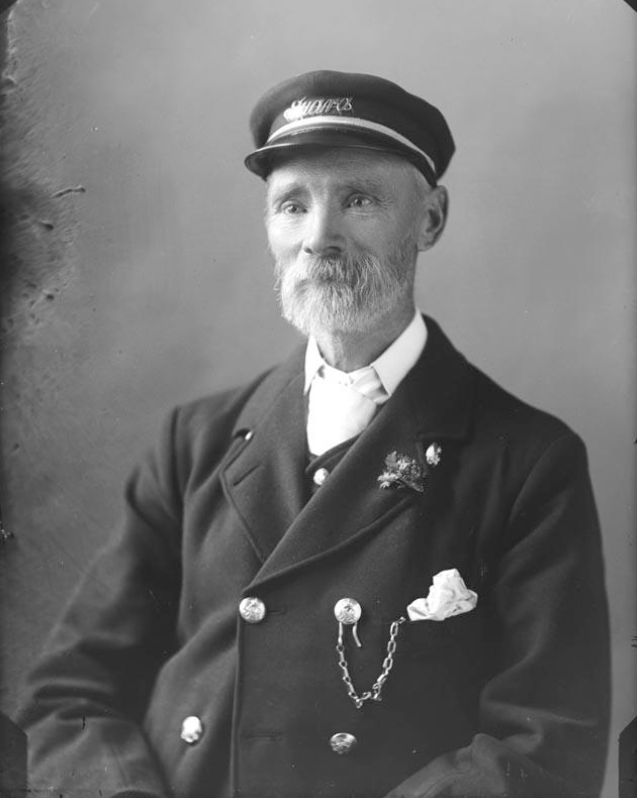
Wakefield now had a resident stationmaster and postmaster combined, and it was gazetted on the 27th of December that year
that from and after the 1st of January 1879, a Money Order and Savings Bank Office would be opened.25
Progress indeed, including a Telegraph Office in 1879. However, the Post Office part of the station was a little room
almost like a cupboard, with a small aperture through which business was conducted. The Postmaster had a great many other
duties including the rail freight, traffic operations, line maintenance and now Telegrams, Money Orders and the Savings Bank.
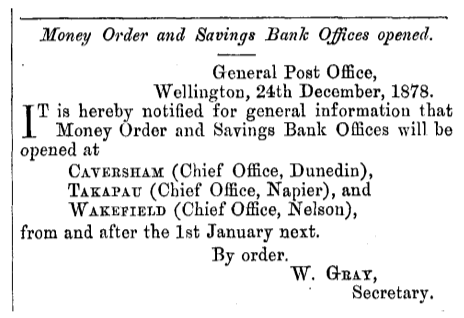
Postermasters/stationmasters were “First and foremost railway men. Being station master at Wakefield was just a small step up the rungs of the Railway career ladder, and they came and went accordingly. Being an isolated railway, many were anxious to get back onto a ‘main line’, where their career prospects were greater.”26
Perusing articles in the newspapers of the times, it becomes apparent that on many occasions the men were transferred and promoted with very little notice, which must have impacted on their families and was often lamented by their communities.
One such example was when Edward Burge’s long tenure as station and postmaster in Wakefield came to an end very early 1897. The community immediately rallied to organise a fitting send off and gifts for the Burge family as he was being transferred to Pahiatua:
“A Public meeting was held in the Temperance Hall on Saturday evening to arrange a farewell social to Mr E. Burge, stationmaster, who is about to sever his connection with this district, and take up his duties at Pahiatua, in the North Island… Mr F. H Smith, of Stanley Brook, mentioned that the people in his district would gladly contribute, as in Mr Burge, the country people had a most obliging stationmaster; that he often put himself out of the way to oblige them. He felt sure that all the surrounding districts would endorse what he said, and that they felt sorry to lose Mr Burge. Mr Samuel Baigent wanted to know why they were shifting Mr Burge, when he suited the district so well. They wished that Mr Burge could stay. He felt sure they could scarcely find a better man anywhere, and that all would miss him greatly.”27
The Colonist report on the Farewell and presentations to Edward included numerous glowing reports of his character, and that of his wife, who would be sorely missed by the entire Waimea South community.
On the 28th of January the Nelson Evening Mail reported “Mr Burge, the popular railway station master at Wakefield, has gained well deserved promotion to the charge of Pahiatua station, and he was entertained at a farewell "social" at Wakefield last evening. Appropriate speeches and presentations were made, and wishes of success in his new labour as well as regret at his departure were expressed. Mr Burge was heartily cheered by the public and his fellow-officials as he left Wakefield by train for Nelson this morning, and cordial farewells were said to him all along the line. When the train reached Nelson a handsome salad bowl and biscuit barrel were presented to Mr Burge by Mr Christophers on behalf of the staff on the Nelson railway. Mr Christophers made an appropriate and complimentary speech, and Mr Burge responded, thanking his fellow-officials for their kindness, and saying he would always have pleasant recollections of the Nelson district and its people. Mr Burge left for the North Island by this afternoon's steamer.”28
Mr Thomas L Felton soon arrived to take up the position. Like Edward Burge before him, Thomas settled his family into the community and was soon involved in many local organisations, including the School Committee, Wakefield Cricket, the Waimea South Athletics Association and the Rechabite Order.
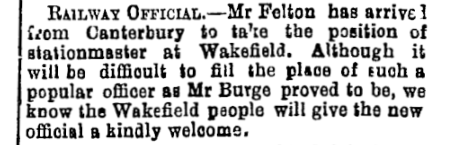
Just over six years later on the 24th of October 1902, a notice of Mr Felton's promotion to the “stationship of Reefton” was posted in
the Nelson Evening Mail29 and his replacement was announced.
Once again the community rallied together to provide a fitting send off to their Stationmaster and Postmaster:
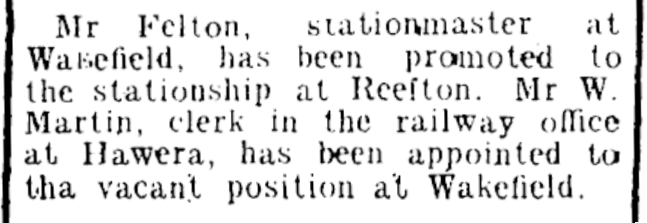
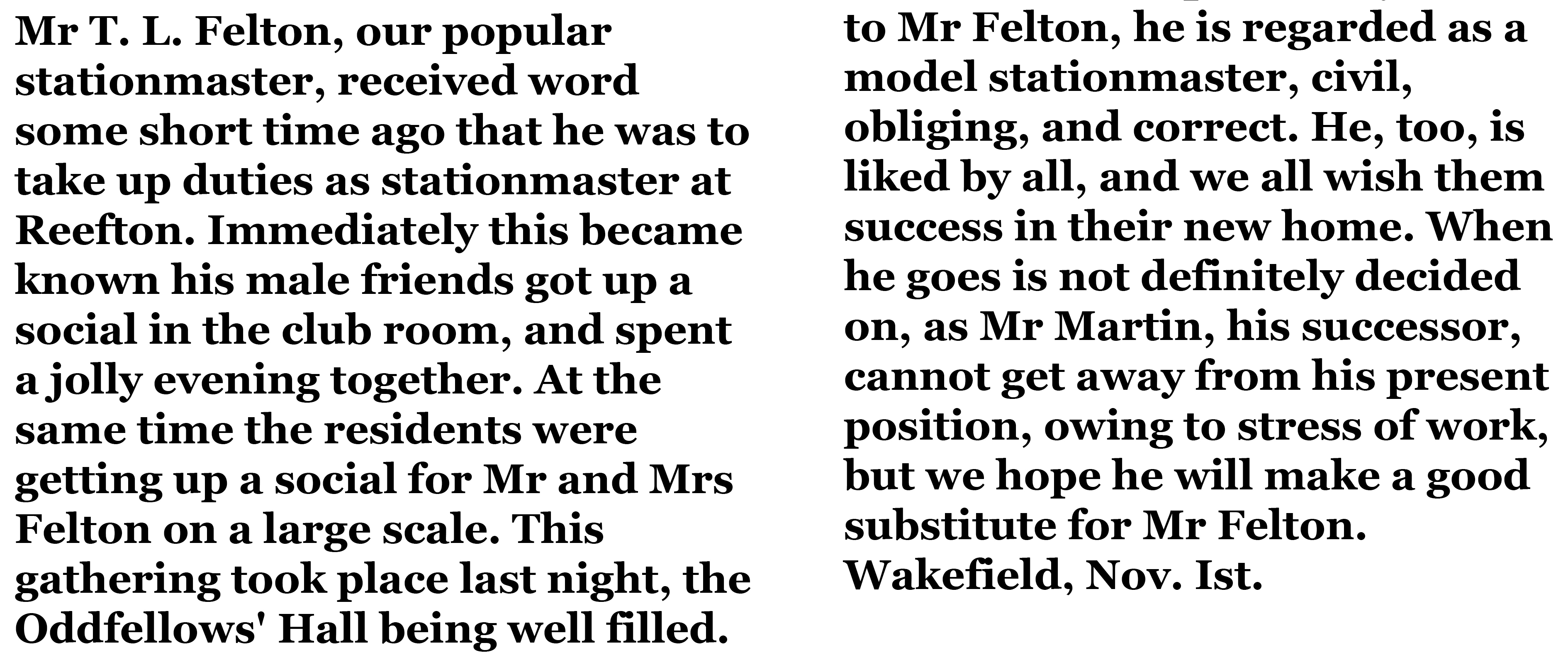
Sadly William Henry Martin died in September 1903, and a report of his funeral on Saturday the 12th appears in the Colonist:
“The funeral of Mr W. H. Martin, late stationmaster at Wakefield, took place in town on Saturday, and the considerable number of Wakefield residents who attended testified to the esteem in which Mr Martin was held, though he had been in Wakefield only a few months. A number of the Railways staff and the Post and Telegraph staff also attended as a mark of respect.”30
A few days later on 19th October the Colonist reported that “Mr J. M. Wilson, of Petone, has been appointed stationmaster at
Wakefield, and will take up his duties during the coming week.”31 By 11 November it was reported that “Our new stationmaster,
Mr Wilson, has now settled down to work, and is becoming quite a favorite among us.”32
Right: During his three year tenure as Station-and-Postmaster, John M Wilson saw some much needed improvements to the Station building
which were lauded in a February 14th (1906) Issue of the Colonist.
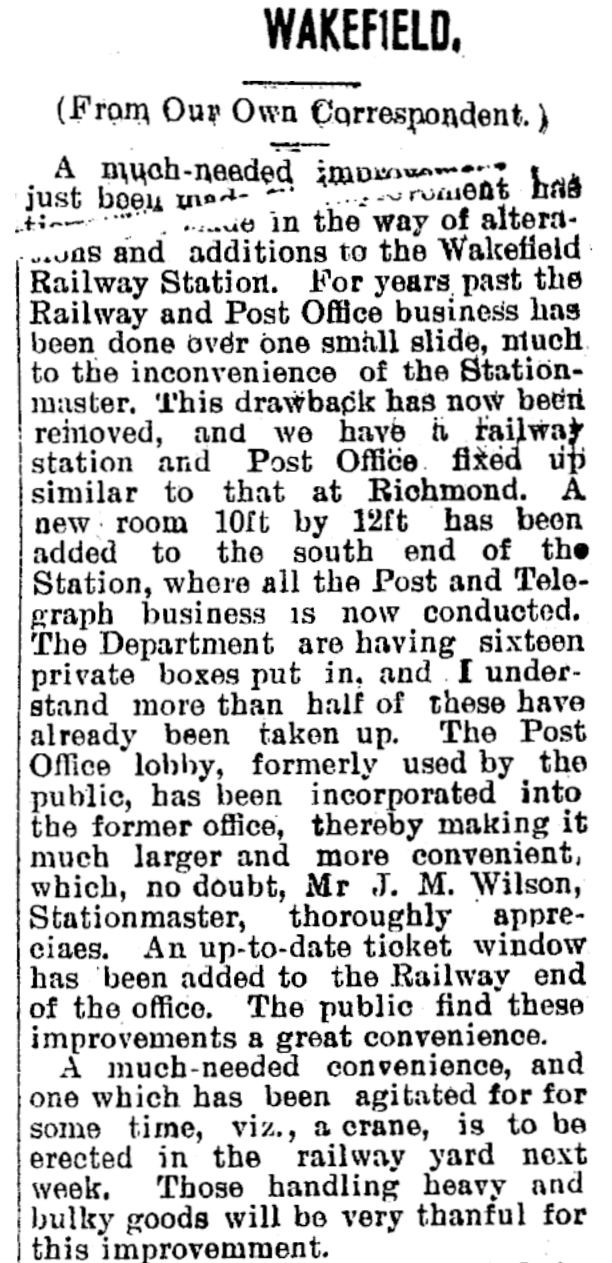
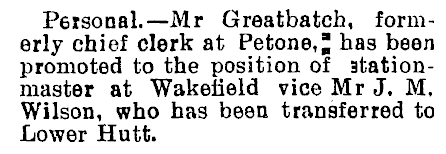
In November, the very popular Mr Wilson received notice of his transfer to Lower Hutt35 and in January 1907 the newspaper reported on the Farewell Social for the Wilsons prior to their departure from the district early the next week, and announced his replacement Samuel Greatbatch from Petone:
“A social gathering which was well attended by residents of Wakefield and surrounding districts was held in the Oddfellows’ Hall, Wakefield on Tuesday evening, January 1st, to bid a formal farewell to Mr and Mrs J. M. Wilson. Mr Wilson having received notice of transfer on promotion to Lower Hutt, is leaving Wakefield early next week.” Mr Wilson was presented with an inscribed silver tea service, in “recognition of the way that he had carried out his duties as stationmaster and Postmaster, during the three years that he had occupied that position.”
By 1907 the range of services being handled by the Wakefield Station and Postmaster had expanded considerably from those offered when the Post Office first removed to the Railway Station in 1878. In October 1907, an article in the Nelson Evening Mail reports on a new and additional system, that of processing special money order payments of teacher salaries:
“Special money order and advice forms, printed on paper of a colour distinct from any other order used, will be supplied by the Post Office, and a form of receipt on each centre will be provided to cover the service in respect of which payment is made. The order may not be drawn for payment outside New Zealand. An officer of a Board will prepare and sign the orders and advices. Orders are not to be posted to teachers until after the advices have been handed to the Chief Post master. The Chief Postmaster is to date, stamp, and countersign the advices, and then forward them to the Post master in charge of the office at which the orders are payable.”36
In December 1907, a series of letters to the Editor prompted by a meeting of local businessmen, discussed the need for improved post office facilities regarding the workload of the Railway staff. Storekeeper E.W Hodgson reports the present staff “consisting of the station master (in charge of the railway office and goodshed work, post office, telegraph, and telephone) and a messenger boy.” He describes the hours worked as excessive, the public telephone being of little use due to the delays being able to use it, and more assistance being necessary. In addition, he hopes “both the businesspeople and the general public will agitate to procure” this assistance.37
Another businessman E McPherson also writes to the Editor that at the same meeting it was believed “that the officer in charge of the Post and Telegraph Office has far more to do than is reasonable to expect of any Government official.” Furthermore, he writes, “it was the unanimous opinion of the meeting held that all credit was due our local officer for the way in which he carries out his duties under existing circumstances”.38
In June 1908, a small notice appears in the Colonist newspaper’s ‘News of the Day’ section, announcing that “Mr McKenzie, M.P., considers that the growth of the district warrants a separate post office and postmistress at Wakefield, and he will endeavour to get one established.”39 Followed by another equally small notice August 20, “Mr McKenzie is also making an effort to get a new Post Office erected at Wakefield.”40
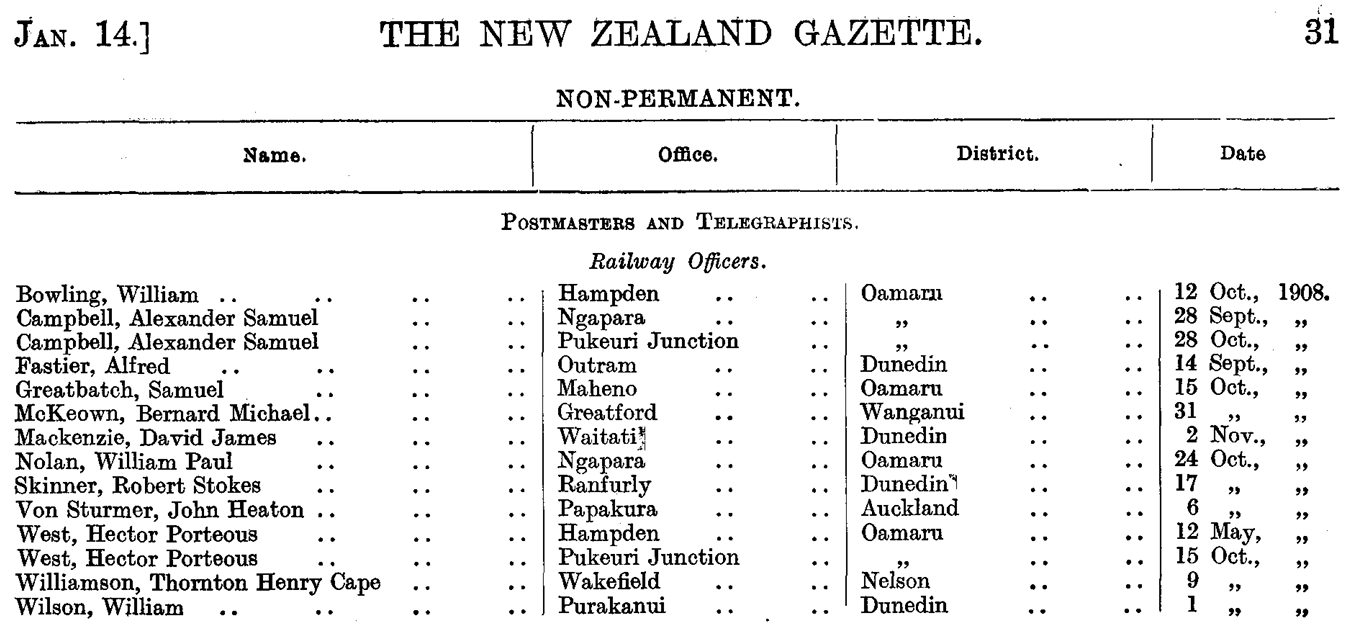
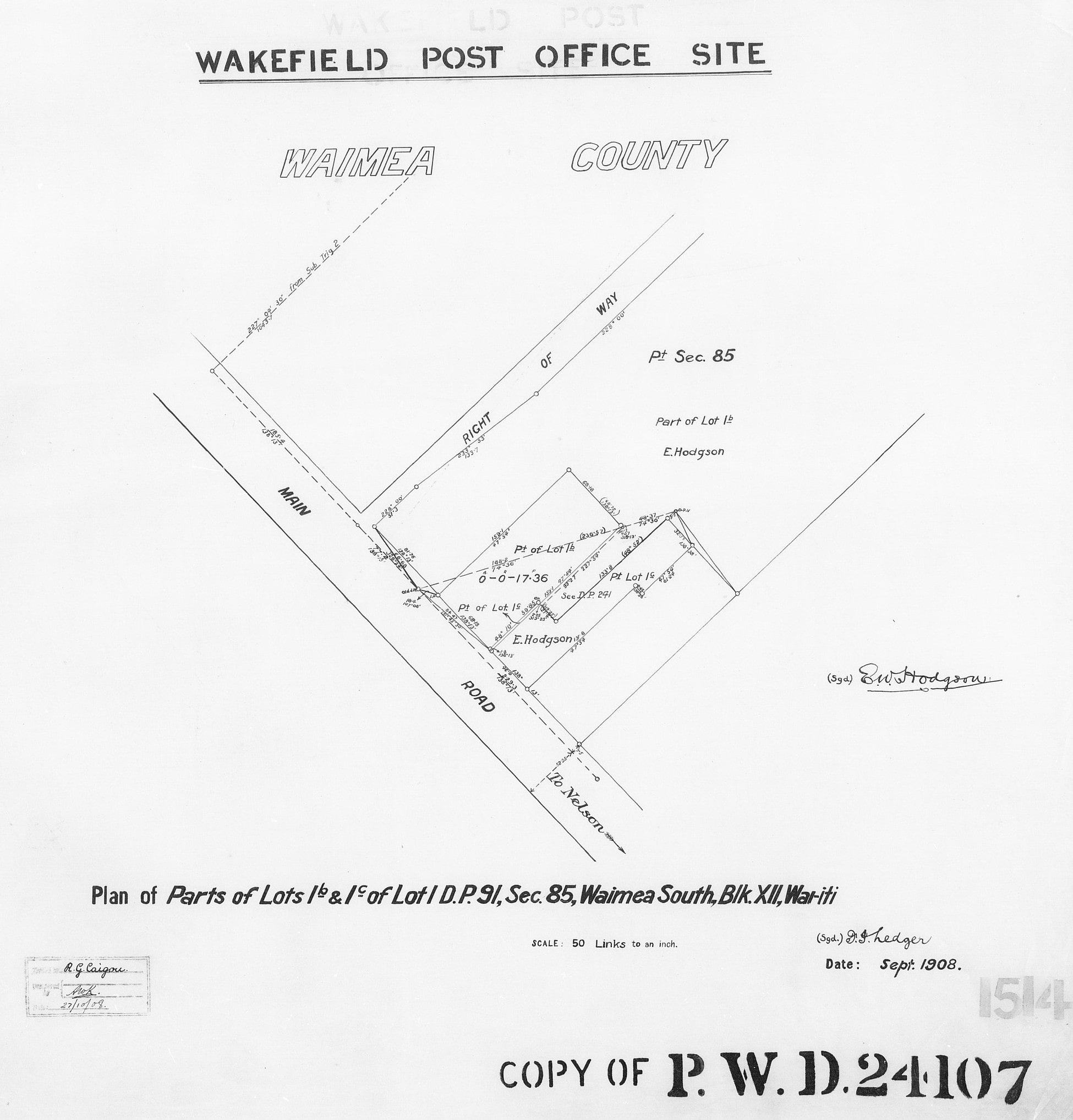
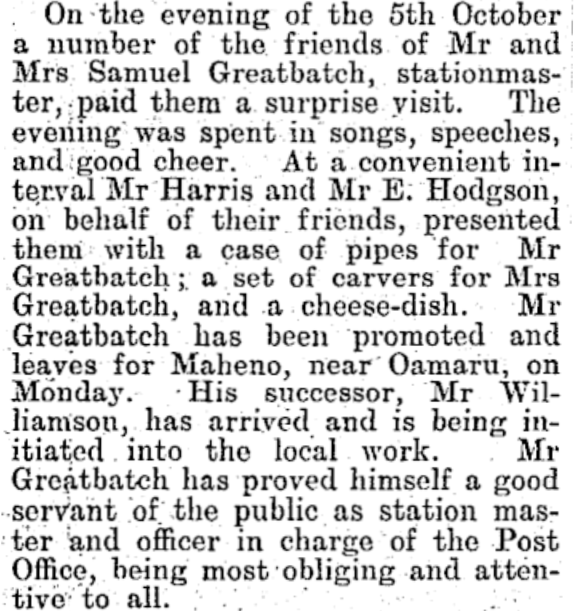
By the time Samuel Greatbatch received notice of his transfer to Maheno in October of 1908, plans were well afoot for the stand alone Post Office for Wakefield. A Public Works Estimates notice in the Nelson Evening Mail, 23 September, shows a sum of £140 for a Wakefield Post Office site,41 and also in that month a site and land plan for the Post Office has been drawn up on section 85, signed by E Hodgson.
Mr Greatbatch was farewelled in typical Wakefield Community fashion early October, and departed for Maheno on October 12. Mr Thornton Henry Cape-Williamson, who was gazetted as postmaster from October 9, had arrived and was reported settling into local work.
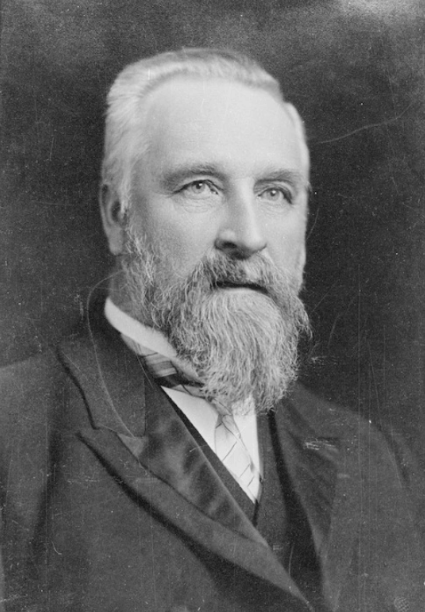
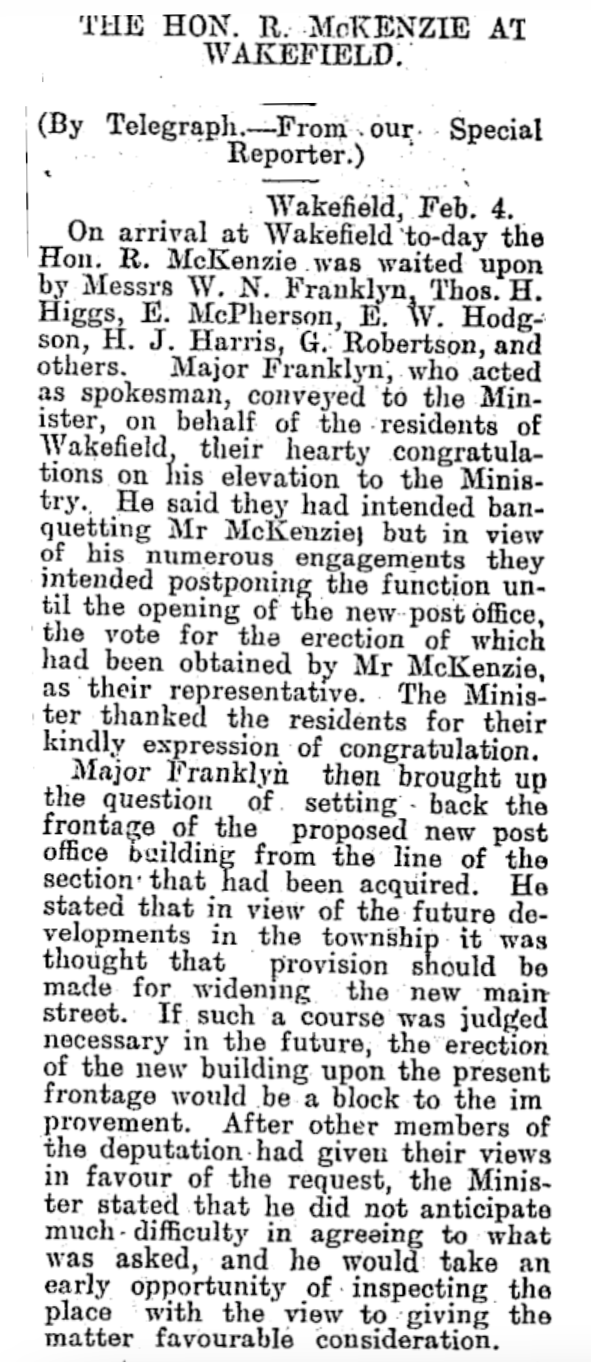
1909 was to be a big year for the Post and Telegraph in Wakefield. Beginning in February with the visit of the newly elected Minister of Public Works, the Hon. Rodrick McKenzie, who had secured the vote for the erection of the Post Office while holding the office of local M.P.
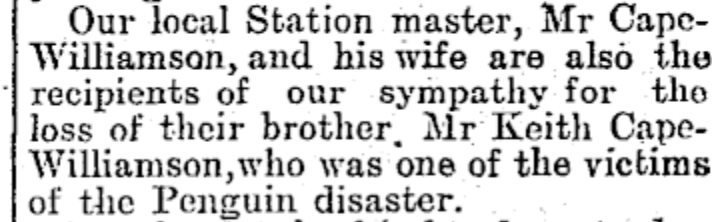
Meanwhile tragedy struck for station master Thornton Henry Cape-Williamson February 12 1909, when his brother was among those lost in the SS Penguin shipwreck.
Not long after this Mr Alfred Naylor Longton was gazetted from March 24 as a non permanent Post master
and Telegraphist (Railway officers).42
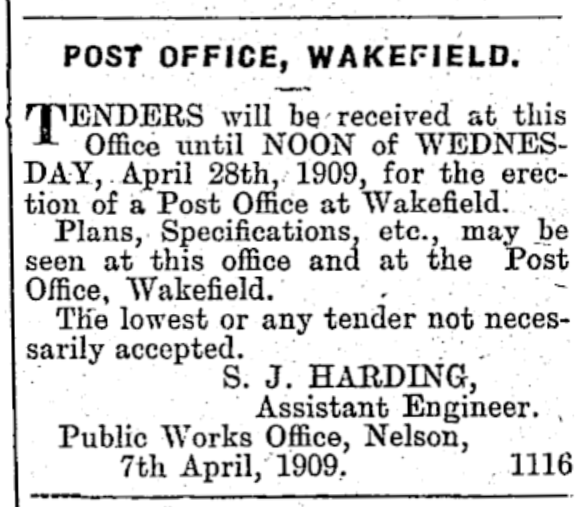
In the April newspapers advertisements were placed by S J Harding, Assistant Engineer at the Public Works Office, Nelson,
announcing that Tenders would be received at his office up until the 28th of the month for the erection of a Post office at Wakefield.
J.K Johnstone’s £800 tender was accepted and announced late May.43
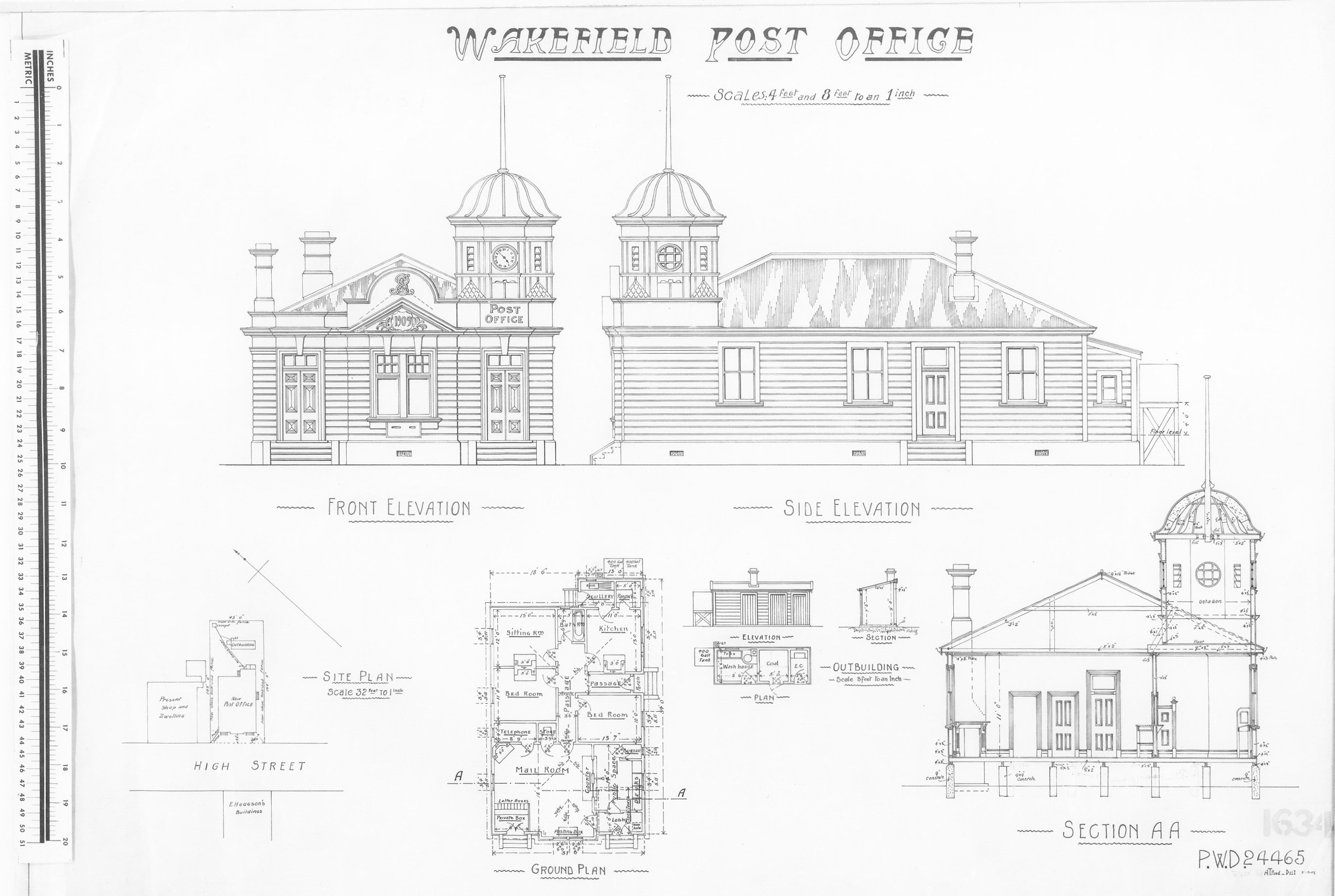
In June 1909 the Colonist reported “The foundations of the new Post office are being laid down on the site opposite Mr Hodgson's store.”44 This was followed by an article in the Nelson Evening Mail, dated August 27th, “The new Post Office is proceeding very satisfactorily; and a little building generally appears to be going on. Mr Hodgson has put up a new shop alongside the Post Office and Mr Hooper has made improvements to his present shop”.45
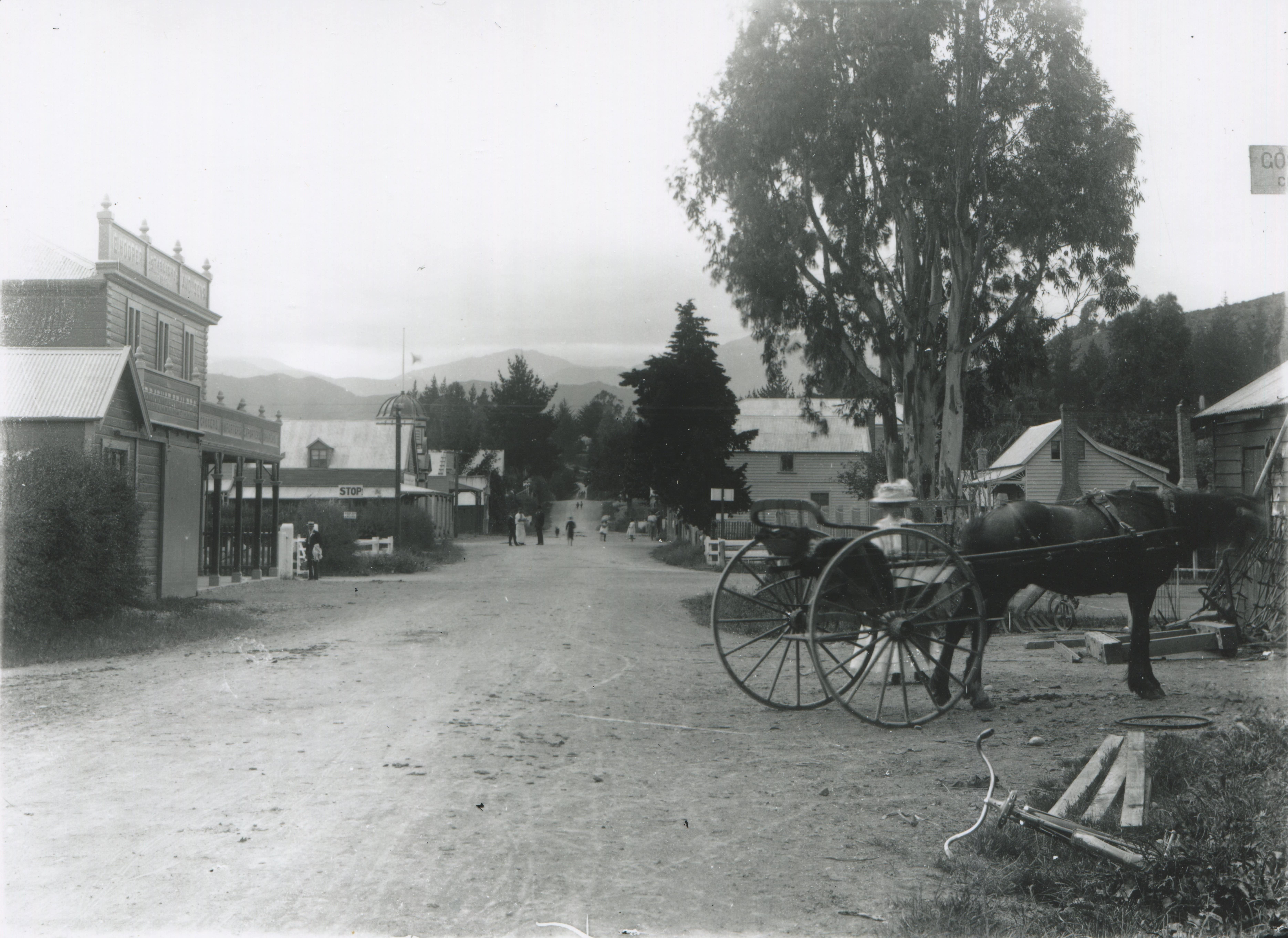
December 1st, 1909, the Colonist reported that “Mr G. Worth, telegraphist, Palmerston North, has been appointed
postmaster at Wakefield. The new office may be opened for business about the middle of next month.”46
This was quickly followed on the 8th by a notice in the Nelson Evening Mail, which reported "The new Post Office just
completed is a building with a good appearance, although rather low. It helps to make the township look more business-like."
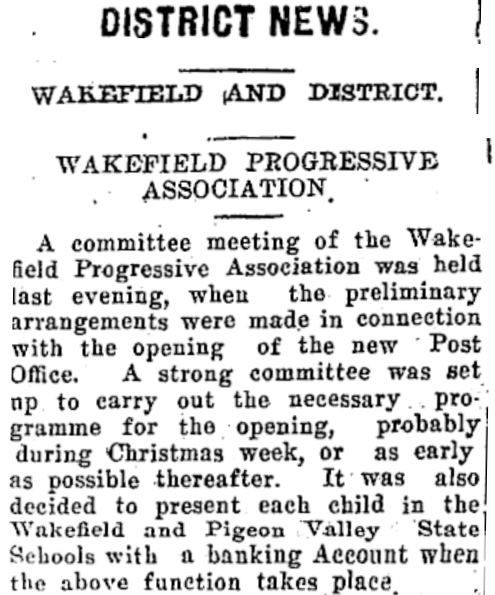
The same article reported that each child in the Wakefield and Pigeon Valley State Schools would be presented
with a banking account when the Post Office opened.
Wakefield Post Office Opening: 1910
Preparations for the Wakefield Post Office opening on January 17, 1910, included bunting across the main street, flags on nearby houses, and a special dais for officials. Despite bad weather, the event was cheerfully reported by both the Colonist and the Nelson Evening Mail. Among those on the dais were the Minister of Public Works, Hon. Roderick McKenzie and his wife, local council representatives, Chief Postmaster E. V. Senn, Telegraph Engineer W. E. Chisholm, Wakefield Progressive Association President E. Hodgson, and other dignitaries, with Mr. W. N. Franklyn presiding.
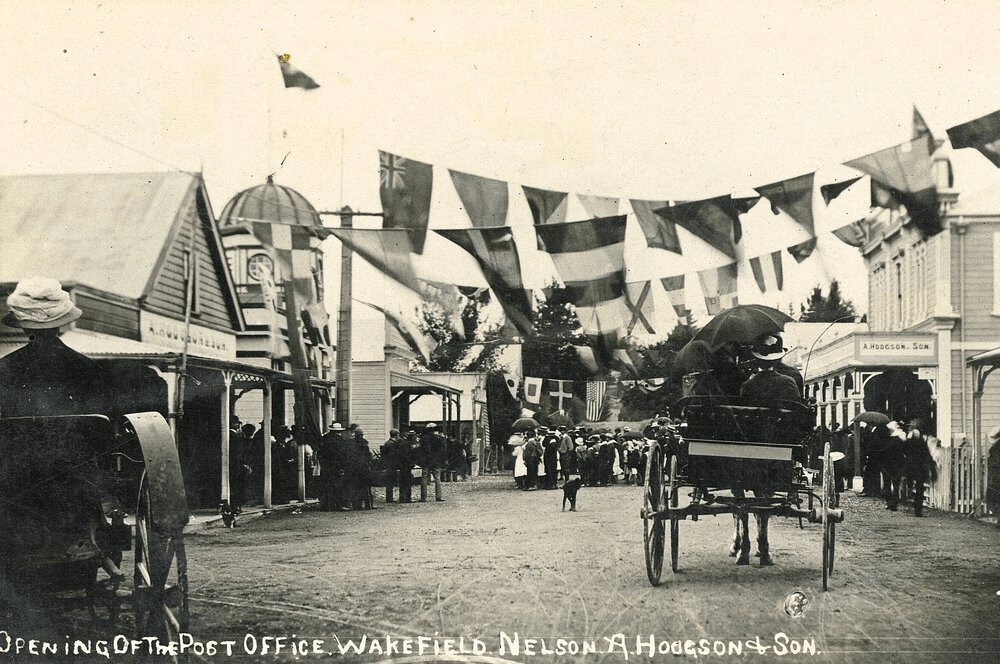
At 3 p.m., schoolchildren assembled as formal ceremonies for the Wakefield Post Office opening began. Mrs. McKenzie received a bouquet, and the Wakefield Brass Band performed. Secretary of the Wakefield Progressive Association, Mr. James Bruce, read congratulatory telegrams, including one from former Nelson mayor Mr. Baigent, before inviting Mr. W. N. Franklyn to chair proceedings. Mrs. Hodgson, granddaughter of Wakefield’s founder Edward Baigent, presented a gold key to Hon. Roderick McKenzie to open the post office. The key, inscribed with the date and McKenzie's initials, symbolized the community’s esteem for him.
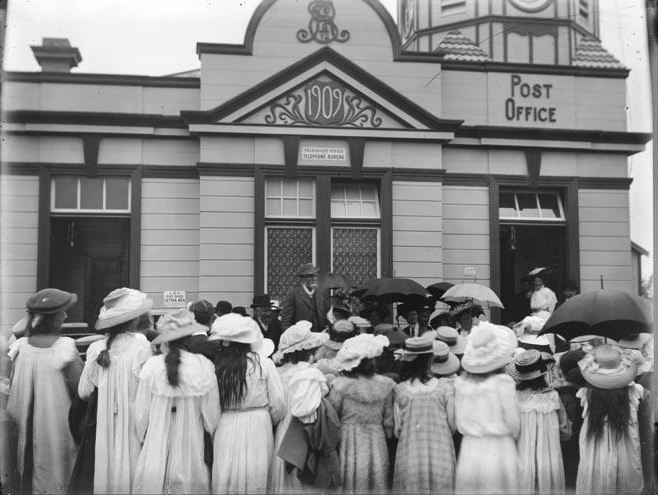
Mr. McKenzie shared the history of postal services in Wakefield and described the new building, which included public offices and living quarters for the postmaster. Contractor J. K. Johnston oversaw construction. After speeches from other dignitaries, the post office was declared open and the public was invited inside.
The celebration continued at the Oddfellows Hall with tea. There, Mrs. McKenzie gave each child from Wakefield and Pigeon Valley a savings bank book and a shilling—thanks to funds raised through an initiative by stationmaster Mr. Longton to promote thrift. The Nelson Evening Mail later reported that Mr. Worth, formerly of Palmerston North, was appointed postmaster, assisted by cadet Mr. Albert Eves.
Where is the story located?
The Wakefield Post Office story is still under development by our team and is not available yet. In the mean time, check out our other stories!
Agumented Reality Experience
Our Augmented Reality (AR) app is currently under development. The app will allow posts to be scanned, bringing the stories into life!
References
- Stringer, Marion J. (1993). To Start a School. In 150 years of Wakefield schooldays, 1843-1993: includes Eighty-Eight Valley, Pigeon Valley, Spring Grove, Totara Bush, Te Arowhenua, Wai-Iti (p. 4). [Wakefield, N.Z.]: Wakefield School 150th Anniversary Committee, 1993.
- Correspondence (1849, May 26) Nelson Examiner and New Zealand Chronicle, Page 50 https://paperspast.natlib.govt.nz/newspapers/NENZC18490526.2.2
- Correspondence. (1850, January 12). Nelson Examiner and New Zealand Chronicle, p.181. https://paperspast.natlib.govt.nz/newspapers/NENZC18500112.2.7
- Dearing, John. (2014). Wakefield. In The Postal History of the Nelson District: Part Two Post and Telephone Offices of Waimea South. p.103.
- Proclamation. (1851, March 8). Nelson Examiner and New Zealand Chronicle, p.5. https://paperspast.natlib.govt.nz/newspapers/NENZC18510308.2.3
- Stringer (1993), p.8.
- Erskine, M. (2018, March). John Squire - From Chemist to School Head Master. Window on Wakefield, p. 21.
- Newspaper stamp. (2025). NZ Post Collectables. https://collectables.nzpost.co.nz/newspaper-stamp/?srsltid=AfmBOoqxDs2z6p9odvJAuDliTZcEzU3LoSqbi85nH37eDh_bwqbd0WtM
- Dearing (2014). p.103.
- Advertisement. (1859, December 14). Nelson Examiner and New Zealand Chronicle, p.4. https://paperspast.natlib.govt.nz/newspapers/NENZC18591214.2.23.2
- Stringer (1993). p.10.
- Ibid.
- New Zealand Gazette Archive. (1866, July 6). 1866 Issue 041, p.286. https://library.victoria.ac.nz/databases/nzgazettearchive/pubs/gazettes/1866/1866%20ISSUE%20041.pdf
- New Zealand Gazette Archive. (1866, October 31). 1866 Issue 057, p.406. https://library.victoria.ac.nz/databases/nzgazettearchive/pubs/gazettes/1866/1866%20ISSUE%20057.pdf
- Government Gazette. (1875, May 27). Colonist, p.3. https://paperspast.natlib.govt.nz/newspapers/TC18750601.2.15
- Report. (1878, July 20). Colonist, p.2. https://paperspast.natlib.govt.nz/newspapers/TC18780720.2.5
- Correspondence. (1878, March 12). Nelson Evening Mail, p.2. https://paperspast.natlib.govt.nz/newspapers/NEM18780312.2.8.3
- Correspondence. (1878, May 7). Nelson Evening Mail, p.2. https://paperspast.natlib.govt.nz/newspapers/NEM18780507.2.10
- New Zealand Gazette Archive. (1878, October 17). 1878 Issue 101, p.1417. https://library.victoria.ac.nz/databases/nzgazettearchive/pubs/gazettes/1878/1878%20ISSUE%20101.pdf
- Correspondence. (1878, August 3). Nelson Evening Mail, p.2. https://paperspast.natlib.govt.nz/newspapers/NEM18780803.2.7
- Correspondence. (1878, October 1). Nelson Evening Mail, p.2. https://paperspast.natlib.govt.nz/newspapers/NEM18781001.2.9#image-tab
- NZ Gazette Archive. (1878, 27 December). 1878 Issue 132, p.1862. https://library.victoria.ac.nz/databases/nzgazettearchive/pubs/gazettes/1878/1878%20ISSUE%20132.pdf
- Dearing, John. (2014). Wakefield. In The Postal History of the Nelson District: Part Two Post and Telephone Offices of Waimea South. p.106.
- Correspondence. (1897, January 26.) Colonist, p.3. https://paperspast.natlib.govt.nz/newspapers/TC18970126.2.11
- Correspondence. (1897, January 28) Nelson Evening Mail, p.2
- Correspondence. (1902, October 24) Nelson Evening Mail, p.2 https://paperspast.natlib.govt.nz/newspapers/NEM19021024.2.6
- Funeral. (1903, September 14) Colonist, p.2 https://paperspast.natlib.govt.nz/newspapers/TC19030914.2.7
- Notice. (1903, October 19) Colonist, p.6 https://paperspast.natlib.govt.nz/newspapers/TC19031019.2.43
- Wakefield items. (1903, November 11) Colonist, p.4 https://paperspast.natlib.govt.nz/newspapers/TC19031111.2.19
- Untitled. (1906, November 21) Colonist, p.2 https://paperspast.natlib.govt.nz/newspapers/TC19061121.2.5
- Payment of School Teachers, 1907. (1907 October 9) Nelson Evening Mail, p.2 https://paperspast.natlib.govt.nz/newspapers/NEM19071009.2.28
- The Wakefield Post Office, 1907. (1907 December 11) Nelson Evening Mail, p.2 https://paperspast.natlib.govt.nz/newspapers/NEM19071211.2.23
- Ibid.
- News of the Day, 1908. (1908 June 18) Colonist, p.2 https://paperspast.natlib.govt.nz/newspapers/TC19080618.2.6
- Murchison County Bill, 1908. (1908 August 20) Colonist, p.4 https://paperspast.natlib.govt.nz/newspapers/TC19080820.2.23.1
- The Public Works Estimates, 1908. (1908 September 23) Nelson Evening Mail, p.2 https://paperspast.natlib.govt.nz/newspapers/NEM19080923.2.31
- NZ Gazette Archive. (1909, May 20). 1909 Issue 40, p.1415 https://library.victoria.ac.nz/databases/nzgazettearchive/Html/1909.html#links
- Cabinet Appropriations, 1909. (1909 May 27) Nelson Evening Mail, p.2 https://paperspast.natlib.govt.nz/newspapers/NEM19090527.2.25
- Country News. (1909, June 23) Colonist, p.1 https://paperspast.natlib.govt.nz/newspapers/TC19090623.2.5
- Miscellaneous Items. (1909, August 27) Nelson Evening Mail, p.4 https://paperspast.natlib.govt.nz/newspapers/NEM19090827.2.85
- Personal. (1909, December 1) Colonist, p.2 https://paperspast.natlib.govt.nz/newspapers/TC19091201.2.11
- Original Wakefield Post Office, c 1910. (Unknown).